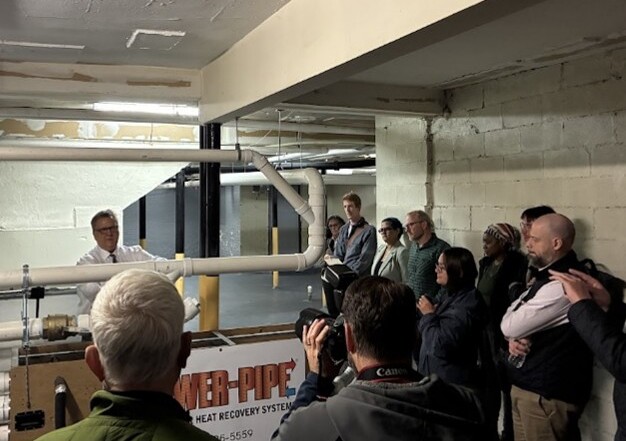

 An innovative energy-efficiency project at CSNDC’s Washington Columbia I and II buildings is putting Dorchester at the forefront of multifamily housing energy conservation. It’s the first time a central horizontal Drain Water Heat Recovery (DWHR) system has been installed in North America. This technology is particularly well suited for installation in multifamily apartments, where many units utilize the same hot water heater and hot water usage is inconsistent.
The system was introduced at an on-site demonstration event at 150-156 Columbia Road on October 28th. The event was co-sponsored by CSNDC’s partners, New Ecology, which is overseeing the project, and LISC, which welcomed members of its Energy Cohort, a peer learning group for affordable housing professionals interested in building decarbonization, climate resiliency and resident health, to the demonstration.
The system was designed and installed by RenewABILITY Energy, a Canadian firm that specializes in energy saving devices for residential, commercial, institutional, commercial, and industrial markets around the world. The installation was paid for through grants from the City of Boston’s Equitable Emissions Investment Fund and Mass Clean Energy Center’s EmPower Massachusetts program.
So, how does a central horizontal DWHR system work?
Whenever people use hot water — for example, in a shower or sink — the water eventually flows down the drain, carrying heat with it. A DWHR system captures some of the heat that would have otherwise been lost and uses it to warm the fresh, cold water that’s entering the building.
The principle is straightforward: recover heat that would otherwise go to waste and put it to use again. The two water streams stay separate: used drain water does not mix with the clean water coming into the building. Instead, the system enables heat to pass from one stream to the other. Because the incoming water is warmer, the building’s water heater needs less energy to bring it to the desired temperature. In this way, the system helps make use of energy that would otherwise have been lost down the drain.
A central horizontal DWHR system utilizes a small buffer tank and a temperature-controlled pump to optimize the recovery of heat from the drain by recirculating drain water to keep both sets of pipe warm. As energy costs have risen, this type of system has become increasingly financially feasible.
The installation at the Washington Columbia I and II buildings has been operational since late 2025. New Ecology is tracking the energy savings from this technology as a case study, to learn how this technology can be applied elsewhere.
This project brings an innovative approach to environmental efficiency and reflects CSNDC’s interest in practical ways to conserve energy in the places where people live and work. It’s one example of how thoughtful building improvements can support a more energy-conscious community.
“This installation is an exciting milestone for CSNDC and a promising opportunity to explore energy conservation in apartment buildings,” said Tim Caplice, CSNDC’s Director of Real Estate & Asset Management. “It reflects CSNDC’s commitment to practical, forward-looking ways to use energy more wisely in our community.”
The simple payback period for the equipment is estimated to be seven years. This means that in seven years CSNDC will have recovered the full cost of installing the new system through reduced energy costs, and once payback is complete, the ongoing savings will help to reduce the ongoing cost of operating the buildings.
You can read more about the DWHR installation at Washington Columbia I and Washington Columbia II in an article from the Dorchester Reporter.